
What Is a Clearinghouse in Medical Billing? (Beginner-Friendly Guide)
- 10/19/2026
- Posted by: Tri Smith, Instructor
- Category: Technical Skills & Coding
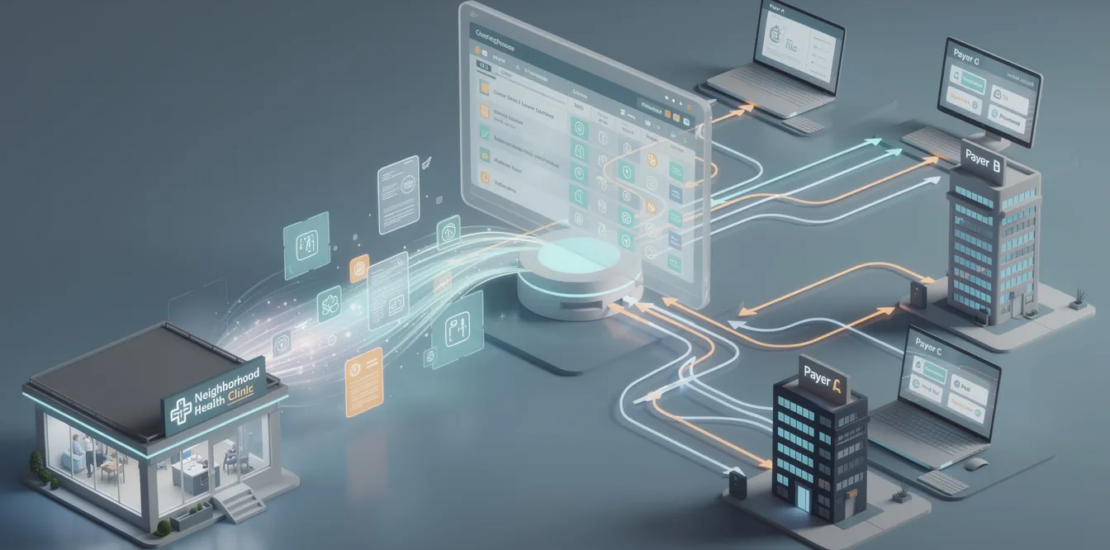
If you are learning what a clearinghouse is in medical billing, start with its role in electronic claim submission. A medical billing clearinghouse helps move claims from a provider’s billing system to the appropriate payer while checking for formatting and data issues along the way.
What Is a Clearinghouse in Medical Billing?
A medical billing clearinghouse acts as an intermediary between healthcare providers and insurance payers. It receives electronic claims from a provider’s billing system, checks them for certain errors and formatting requirements, and routes them electronically to the appropriate payer. Many practices use a clearinghouse rather than maintaining separate electronic claim connections with multiple payers.
Here is what beginners need to know:
-
Clearinghouses work with electronic data interchange (EDI) transaction sets like ANSI X12 837 for professional and institutional claims.
-
Without a clearinghouse or another intermediary solution, a practice may need to manage separate payer connections, portals, and submission requirements across the plans it bills, which is unrealistic for most small offices.
-
Healthcare clearinghouses operate within HIPAA’s administrative simplification and privacy/security framework and must handle protected health information appropriately.
-
Clearinghouses reduce administrative workload by managing multiple insurance connections through a single platform.
-
For example, a family medicine clinic may send claims from its billing software to one clearinghouse, which then routes them to multiple government and commercial payers.
Where a Clearinghouse Fits in the Revenue Cycle
Understanding what is a clearinghouse in medical billing means knowing where it sits in the revenue cycle: after coding and charge entry and before payer adjudication. Its role can affect claim status, rejection handling, and how quickly submission problems are identified before payer adjudication.
A simplified revenue cycle looks like this: patient registration, eligibility verification, encounter and coding, claim creation, clearinghouse claim scrubbing and transmission, payer adjudication, electronic remittance advice and automated payment posting, then patient billing for remaining balances.
Many clearinghouses provide claim-status reporting and return electronic acknowledgment information that helps billing staff identify submission problems. They may also route electronic remittance advice from payers back to the practice for payment posting.
For example, a billing team may submit a batch of claims and receive acknowledgment or rejection information showing which claims passed initial edits and which require correction. The biller can correct rejected claims before they move further through the payment process.
What Does a Medical Billing Clearinghouse Do?
-
Claim scrubbing and validation: checking claim data such as demographics, policy IDs, codes, modifiers, provider identifiers, and dates of service against available formatting and payer-specific edits.
-
EDI processing: handling standard electronic claim transactions such as the 837 and related acknowledgments and status responses. Billers may also encounter transaction sets such as the 999, 277CA, and 835 as claims move through the revenue cycle.
-
Claim transmission and payer routing: sending scrubbed claims to the appropriate payer, whether a commercial plan, Medicare Administrative Contractor, or state Medicaid program.
-
Eligibility verification: confirming patient coverage status before service delivery, using 270/271 EDI transactions.
-
Claim status and reporting: dashboards showing accepted, rejected, pending, and paid claims.
-
Payment posting support: routing the ERA (835 file) so it can be imported into the practice management system to post payments.
-
Secure data handling: protecting protected health information consistent with HIPAA requirements.
Common clearinghouse edit messages may identify issues such as an invalid subscriber ID, missing place of service, or invalid diagnosis pointer.
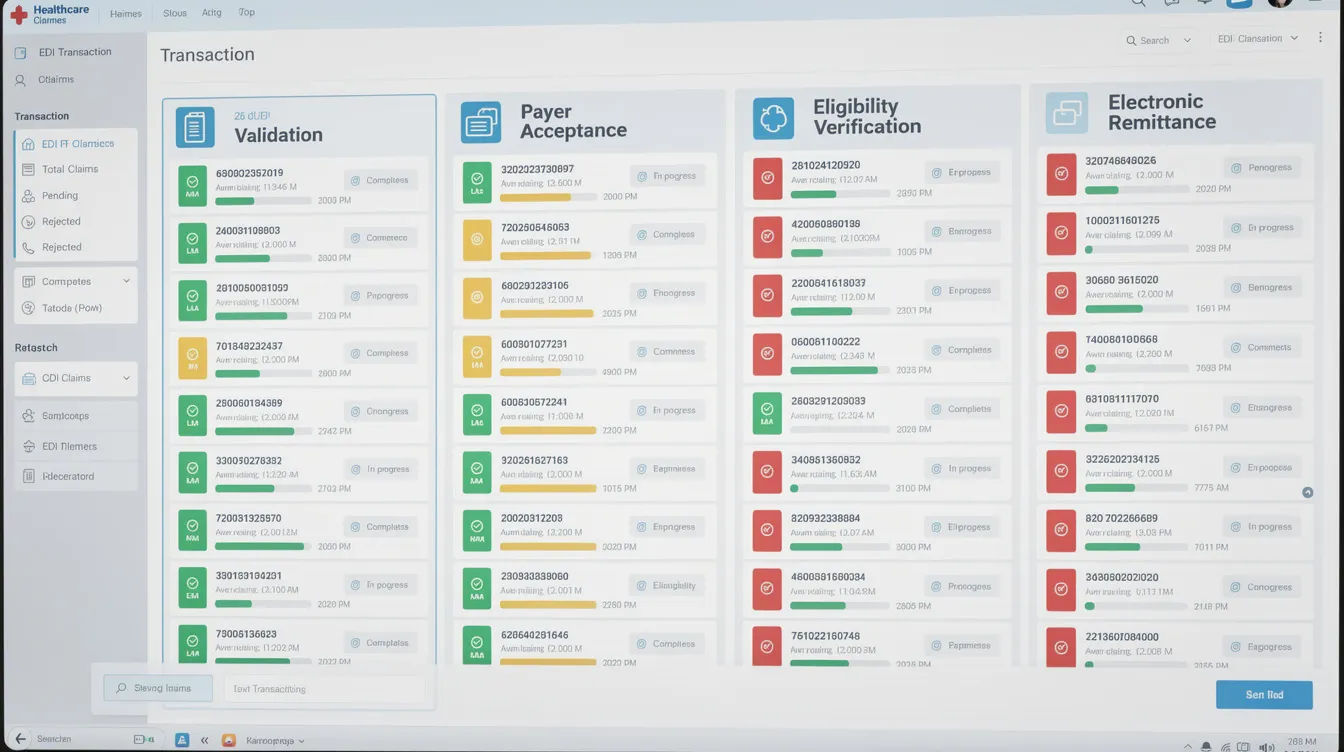
Understanding the EDI Transactions Behind the Scenes
New billers do not need to memorize every EDI transaction code, but recognizing the common ones makes clearinghouse reports much easier to read:
|
Transaction |
What It Does |
|---|---|
|
837 |
The electronic claim itself, submitted from the provider’s billing system to the clearinghouse and on to the payer |
|
999 |
A functional acknowledgment confirming whether the submitted file met basic formatting requirements |
|
277CA |
A claim-acknowledgment report showing which claims were accepted for adjudication and which were rejected, with reason codes |
|
835 |
The electronic remittance advice, showing how the payer processed and paid each claim line |
|
270/271 |
An eligibility request and the payer’s response confirming a patient’s coverage |
|
A biller who understands this sequence can look at a clearinghouse dashboard and know immediately whether a claim is still moving through initial edits, has been accepted for payer adjudication, or has already been paid or denied. |
Common Claim Rejections and Clearinghouse Edits
For example, an office-visit claim may be rejected because the subscriber ID does not match the payer’s records. The biller corrects the error and resubmits, and the corrected claim can reach the payer far faster than waiting for a paper denial.
A clearinghouse catches many issues before the payer sees the claim: data-entry mistakes like misspelled names or mismatched policy numbers; coding and modifier errors, including invalid codes or mismatched diagnosis-to-procedure relationships; formatting and EDI issues where a file does not meet current ANSI X12 standards; eligibility problems such as billing for terminated coverage or primary-versus-secondary confusion; duplicate claims from accidental resubmission; and incomplete provider details like a missing NPI or outdated taxonomy.
By identifying certain problems before payer adjudication, clearinghouses can help billing staff correct claims earlier in the process, rather than waiting weeks to learn about the same issue from a payer denial.
Benefits of Using a Clearinghouse
Part of understanding what is a clearinghouse in medical billing is recognizing the benefits it brings: earlier detection of claim errors, centralized payer connectivity, improved claim-status visibility, easier multi-payer management, and reduced manual handling of electronic transactions, which together can lower administrative costs for the billing team. A single clearinghouse connection can replace dozens of direct payer connections, and standardized electronic transactions can reduce manual data entry compared with paper-based or payer-by-payer submission.
Types of Clearinghouses
What is a clearinghouse in medical billing beyond claim submission? Clearinghouses vary in their integrations and available tools. Some focus primarily on claim submission and acknowledgments, while others also support eligibility checks, claim-status tools, remittance routing, reporting, and denial-management workflows. Some connect directly inside an EHR or practice management system, while others are accessed through a separate web portal. The exact feature set depends on the platform and the practice’s billing system.
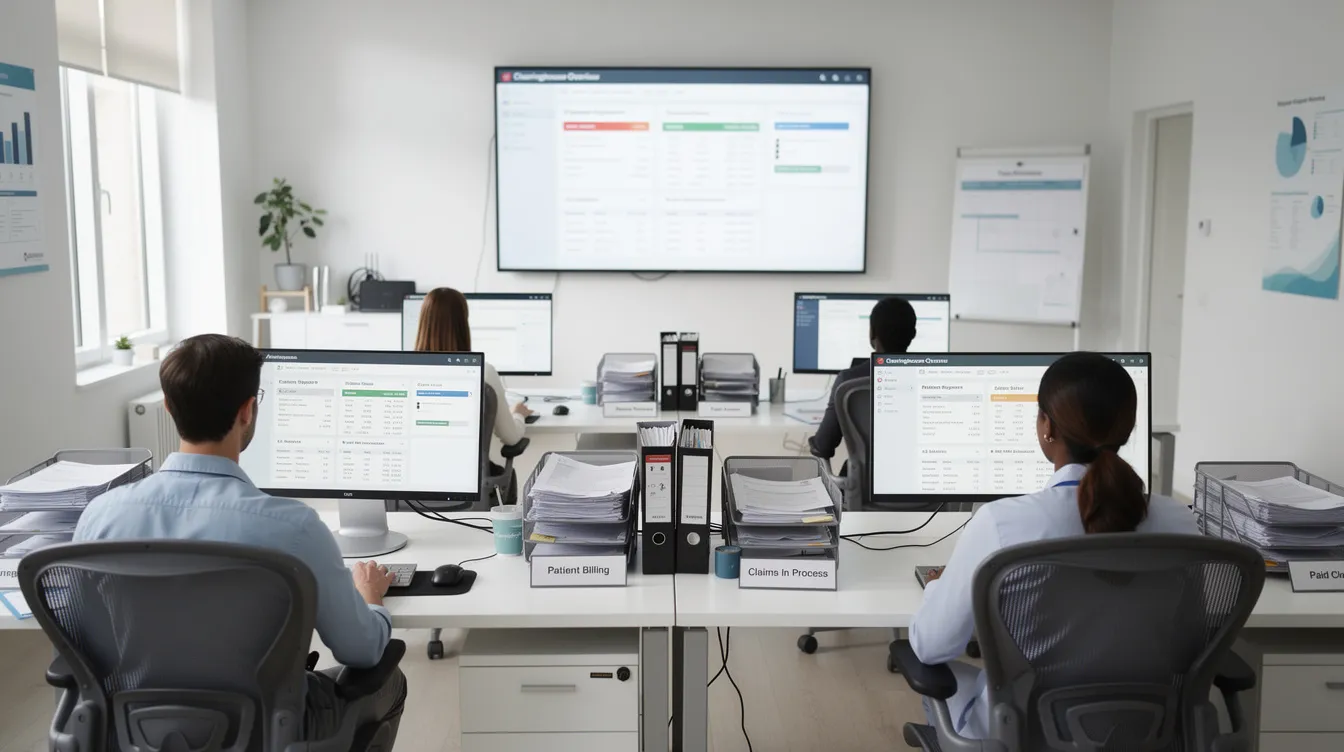
How to Choose the Right Clearinghouse Partner
Key evaluation criteria: integration compatibility with your practice management system and EHR; payer network strength for Medicare, state Medicaid, and the commercial payers you bill most; claim scrubbing depth with frequently updated, payer-specific edits; eligibility verification tools front-desk staff can use before the visit; reporting with clear dashboards for status, denial trends, and productivity; support with responsive service and plain-language edit-code documentation; cost structure, including whether fees are based on claim volume, providers, transactions, or a recurring subscription; and security, with documented HIPAA compliance and incident response procedures. Practices should also consider business-continuity planning, since disruptions at a clearinghouse or connected network can interrupt claim submission and payment workflows.
For new billers, the transferable skill is understanding the workflow rather than memorizing one specific platform, since most clearinghouses organize claim status and rejections around the same underlying EDI transactions.
What New Medical Billers Should Know
Understanding clearinghouse workflows is a practical skill because electronic claim submission is part of routine revenue cycle work. Key skills to develop include reading and interpreting rejection reports and EDI acknowledgment files such as 999 and 277CA messages; correcting claim-data issues identified during clearinghouse edits and routing coding-related problems to the appropriate workflow when needed; using eligibility verification tools proactively to prevent coverage-related denials; tracking claim status through each stage and following up strategically instead of waiting on a payer response; and reconciling ERA/835 files with practice management balances.
For a new medical biller, the key is understanding the sequence: create the claim, submit it through the clearinghouse, review acknowledgments or rejection messages, correct problems when necessary, and track the claim as it moves to the payer. Once that workflow is clear, the clearinghouse becomes much easier to understand as one technical part of the larger revenue cycle.

Tri Smith is a Managing Partner and Instructor at MedicalBillingCourse.com, where he helps guide the program’s direction, curriculum, and student experience. With more than six years of experience, he focuses on practical medical billing skills, including claims, payer communication, compliance, and the full billing lifecycle.
Tri also helped lead the development of the 2026 course edition, including the Medical Billing and Coding certification track. His approach emphasizes clear instruction, practical application, and preparing students to apply what they learn in real-world billing environments.


