
- 09/07/2026
- Posted by: Tri Smith, Instructor
- Category: Revenue Cycle
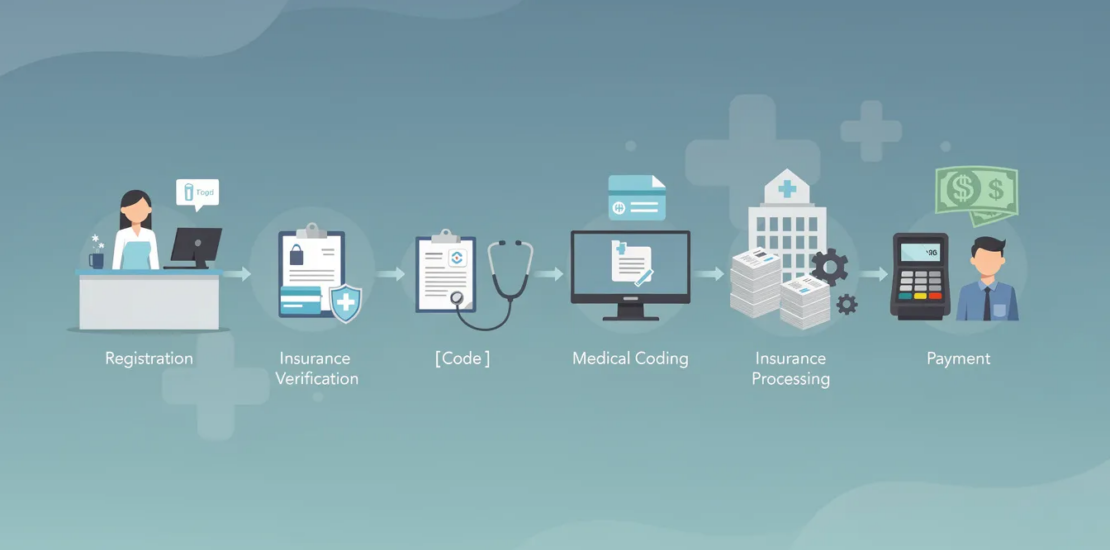
The medical billing process is the structured workflow that transforms a patient visit into collected revenue, starting with the first phone call to schedule an appointment and ending when the account reaches a zero balance. Each step in this process carries real financial consequences for healthcare providers, payers, and patients alike. This guide walks through the complete medical billing process steps as they happen in U.S. practices today, covering patient registration through final payment collection and reporting.
This guide is the current, comprehensive step-by-step overview of the entire medical billing process. For a deeper look at the insurance side of the cycle specifically, see why the health insurance claim cycle matters, the individual steps of the claim cycle, and how medical billers work within the claim cycle.
Introduction to the Medical Billing Process and Revenue Cycle
Medical billing is integral to the revenue cycle, which includes patient registration, documentation, billing, and payment processes. The medical billing process transforms clinical encounters into financial revenue, and a well-run billing cycle typically takes 30 to 50 days from the date of service to payment reconciliation, depending on the payer and claim complexity.
Three core parties drive this workflow: the patient, the healthcare practice, and the payer (insurance company). Medical billing software connects these parties by managing everything from eligibility checks and charge entry to claim submission and accounts receivable tracking. Understanding concrete medical billing process steps is critical for the financial health of modern healthcare organizations and for new medical billers entering the field. It’s also worth being clear on the difference between medical billing and medical coding before diving into the steps below, since the two functions work together but aren’t the same job.
Key components of the medical billing process include patient registration, insurance verification, medical coding, and claim submission. MedicalBillingCourse.com trains students on this exact end-to-end workflow in its 2026 Edition certification programs.
Why a Strong Medical Billing Cycle Matters for Financial Health

An accurate, efficient medical billing process directly supports a clinic’s cash flow, payroll, and ability to invest in equipment and staff. Revenue cycle management ensures timely payment collection for healthcare services, and when that cycle breaks down, the consequences hit quickly.
Common sources of revenue leaks in the medical billing process include:
-
Missed eligibility checks that result in claims sent to the wrong payer or with expired coverage
-
Weak clinical documentation that fails to support medical necessity, triggering denials
-
Poor denial follow-up where recoverable claims are written off instead of appealed
-
Registration errors like outdated member IDs or misspelled names that cause outright rejections
For example, a practice billing $1 to $2 million annually with a 5 to 10 percent preventable denial rate can be looking at $50,000 to $200,000 in avoidable lost revenue each year. That’s a useful illustration of why front-end accuracy matters so much.
A methodical medical billing process reduces rework, supports regulatory compliance with HIPAA (the Health Insurance Portability and Accountability Act) and the No Surprises Act, and builds patient trust. The steps below mirror what billing specialists actually do day-to-day across U.S. healthcare settings.
Step 1: Patient Registration and Preregistration
Patient registration is the first step in both the revenue cycle and the medical billing process. It sets the data foundation for every step that follows.
Patient preregistration happens before the patient arrives, typically by phone or through a patient portal. Staff capture demographics, contact details, and primary or secondary insurance information in advance. When a patient schedules an appointment, the billing team begins collecting data that will follow the claim through its entire lifecycle.
Concrete data points billers rely on include:
-
Legal name, date of birth, gender, and address
-
Insurance payer name, policy number, and group number
-
Subscriber name and relationship to patient
-
Secondary or tertiary insurance details
-
Employer information (if relevant)
For new patients (generally those not seen in the last three years), a fuller demographic and history capture is needed. Established patients still require confirmation of updates at every visit, especially around January when many employers change plans.
Patient registration captures demographic information and current insurance policy data, and accurate patient registration prevents claim rejections later. Something as minor as a misspelled name or wrong date of birth is a leading cause of rejections downstream.
Many healthcare practices use integrated EHR and practice management systems, so this patient data feeds directly into the next steps of the medical billing process, including insurance verification and claim creation.
Step 2: Insurance Verification and Financial Responsibility
Before services are rendered, this stage of the medical billing process requires the billing team to confirm active coverage and determine who pays what. Insurance verification confirms patient eligibility and active coverage, ensuring there are no surprises for either the practice or the patient.
Insurance verification involves checking:
-
Coverage dates and plan type (HMO, PPO, EPO, Medicare, Medicaid, Medicare Advantage)
-
Whether the provider is in-network
-
Copay, coinsurance rate, and remaining deductible
-
Out-of-pocket maximum
-
Visit limits for services like physical therapy or behavioral health
-
Whether prior authorization is required
For example, suppose a patient with a PPO plan is scheduled for an MRI of the knee. Before that date, staff verify that the patient’s insurance coverage is active, the imaging center is in-network, the remaining deductible, whether prior authorization is required (many PPOs require it for MRI), and what the patient’s out-of-pocket share will be.
This is also the stage where prior authorization requirements are often identified, especially for high-cost imaging, surgeries, biologic drugs, or durable medical equipment.
Once the patient’s coverage and financial responsibility are clear, the practice communicates an estimate. Having the patient sign a financial responsibility agreement reduces surprise bills, supports patient satisfaction, and strengthens the practice’s financial health. This stage is explored in full in MedicalBillingCourse.com’s guide to verification of insurance.
Step 3: Prior Authorization and Precertification
Prior authorization is a critical checkpoint in the medical billing process: the payer’s advance approval for specific medical procedures, medications, or medical services. Skipping this step can result in denied claims even when the service was medically necessary.
Staff submits clinical details to the insurance company for review, including diagnosis codes, planned procedure codes, supporting medical records, and sometimes prior imaging or lab results. The submission follows payer-specific forms, portals, or increasingly, electronic APIs.
Under CMS’s Interoperability and Prior Authorization Final Rule (CMS-0057-F), impacted payers must respond to standard prior authorization requests within 7 calendar days and expedited (urgent) requests within 72 hours, effective January 1, 2026. Full FHIR API implementation is required by January 1, 2027.
Consider this practical scenario: a commercial payer requires prior authorization for a CT scan. The billing team submits the request with the CT code, ICD-10 diagnosis, and supporting clinical records. If approved, the authorization number and valid dates are recorded. If denied, the team either modifies the request or prepares an appeal.
The financial risk of skipping prior authorization is substantial. Even medically necessary services can be denied as “no auth on file,” leaving patients or practices with large uncovered balances, including potential out-of-network charges.
MedicalBillingCourse.com’s billing and coding tracks teach students how to read payer policies and document medical necessity effectively within these workflows.
Step 4: Patient Encounter, Clinical Documentation, and Medical Records
When a patient arrives for their visit, this stage of the medical billing process generates the clinical documentation that drives everything downstream. The patient encounter creates the medical records that coders, billers, and payers all depend on.
During a patient’s visit, providers document:
-
Chief complaint and patient’s medical history
-
Physical exam findings
-
Diagnoses and diagnostic impressions
-
Procedures performed, time spent, and medical decision-making complexity
-
Medications prescribed, injections given, or supplies used
-
Counseling or coordination of care
Medical documentation must be thorough to support the claims process and ensure revenue capture. Documentation that clearly establishes medical necessity protects against payer audits and post-payment recoupments.
Electronic health record systems and templates help standardize documentation, but medical billers and medical coders must still validate completeness. A template with blank fields does not constitute documentation.
For example, consider a level-4 established office visit for a patient with uncontrolled type 2 diabetes. The documentation must include current labs, medication changes, complications, and co-morbidities to support the higher-level evaluation and management (E/M) code selected. E/M coding is covered in depth in MedicalBillingCourse.com’s evaluation and management coding guide. Clean clinical documentation sets up accurate medical coding, charge entry, and ultimately correct payer adjudication.
Step 5: Medical Coding (ICD-10, CPT, HCPCS)
Medical coding is the step in the medical billing process that translates clinical documentation into standardized alphanumeric codes payers use to process claims. This step sits at the intersection of patient care and reimbursement.
ICD-10-CM covers tens of thousands of diagnosis codes. CPT codes describe the treatments administered to patients and the procedures performed by healthcare providers, and the RVU behind each code is part of what determines what a service actually pays.
Common coding risks include unbundling (billing multiple codes when one encompasses the service, covered in depth in its own guide to unbundling), upcoding (selecting a higher level of service than documentation supports), missing modifiers (such as modifier -25 for a significant E/M on the same day as a procedure), and mismatched diagnosis-procedure pairs.
Coding errors can lead to claim denials and delayed payments. Accurate coding is essential for timely reimbursement from insurers and also affects risk scores, payer contract compliance, and audit exposure.
MedicalBillingCourse.com’s combined Medical Billing & Coding Certification track teaches students to apply ICD-10 and CPT rules in realistic billing scenarios.
Step 6: Charge Capture and Charge Entry
Charge capture is the stage of the medical billing process that gathers all billable services from the patient encounter, often via a superbill or EHR charge capture tool. Charge entry then involves inputting those coded services and their fees into the medical billing software or practice management system.
The billed charge is not necessarily what the insurance company pays. Provider fee schedules, payer contracts, and allowed amounts all factor in. Charge entry must reflect billed charges accurately so that contractual adjustments can be applied correctly after payer adjudication.
For example, during a family medicine visit, the provider performs an exam (CPT 99203), runs a rapid flu test (CPT 87804), and administers a flu injection (CPT 90686 + 90471). Each service must be captured and entered. If the injection is missed, the practice loses that revenue without ever knowing it.
Many revenue cycle teams use daily charge reconciliation reports, comparing provider clinical logs against charges in the billing system to ensure every documented service is billed once and only once. Missed charges quietly erode revenue and distort financial reports over time.
Step 7: Claim Creation, Scrubbing, and Submission
Once coded charges are entered, this stage of the medical billing process compiles coded data into a standard electronic claim form. Professional services typically use the CMS-1500 form; facility services use the UB-04.
Claim creation must include accurate patient and provider information as well as supporting documentation. Before submission, claims go through scrubbing, which includes both automated and manual checks:
-
Valid provider NPI
-
Correct payer ID and patient insurance information
-
Valid diagnosis and procedure codes
-
Required modifiers present
-
No duplicate claims
-
Timely filing compliance
Automated claim scrubbing technology catches errors in claims before submission. Clearinghouses validate claims to ensure compliance with specific payer guidelines and handle payer-specific rules, such as different modifier usage across different insurance providers.
Claims are typically submitted electronically through a clearinghouse. Claim submission must happen within each payer’s filing deadline: miss it, and an otherwise-clean claim can be denied on timeliness alone.
Errors in claims can lead to denials and delayed payments, so claims must be as error-free as possible to maximize reimbursement efficiency. A high first-pass clean claims rate significantly reduces rework and shortens the medical billing cycle overall.
MedicalBillingCourse.com trains learners using real CMS-1500 examples so they understand how encounter details flow into each claim field.
Step 8: Payer Adjudication, Payment Posting, and Reconciliation
Payer adjudication is the stage in the medical billing process where the insurer reviews the claim and decides payment responsibility. This is the payer’s internal review, where submitted claims are approved, partially paid, denied, or rejected.
It’s worth being precise about the difference between a rejection and a denial, since rejected and denied claims are not the same thing and the fix for each is different:
-
Rejections: format or basic data errors returned quickly for correction before processing
-
Denials: processed claims that the insurance company pays nothing on due to benefit, policy, or documentation issues
Payers communicate results via electronic remittance advice (ERA) and Explanation of Benefits (EOB). The Explanation of Benefits outlines what was paid, adjusted, or denied by the insurer, including adjudication codes and the patient’s remaining responsibility.
Payment posting records insurance payments to patient accounts. This step involves applying ERA and EOB amounts, splitting the insurance payment from patient responsibility (deductible, copay, coinsurance), and recording contractual adjustments. Accurate payment posting prevents billing discrepancies and keeps financial records reliable.
Reconciliation workflows compare posted payments to bank deposits and expected allowed amounts per contract to catch underpayments or missing remittances.
For example, a Medicare Part B claim is adjudicated with an allowed amount of $200. If the patient has met their deductible with 20 percent coinsurance, the insurance company pays $160, and the remaining $40 is billed to the patient.
Step 9: Denial Management, Appeals, and AR Follow-Up
Denial management is a crucial safeguard within the medical billing process, protecting practice revenue and overall revenue cycle health. Without structured follow-up, denied claims simply become lost revenue. Reducing denials starts with understanding why claims fail in the first place. This step of the process is where that prevention work pays off.
Common denial reasons include:
-
Invalid member ID or patient data errors
-
Late filing (beyond timely filing limits)
-
Missing prior authorization
-
Non-covered healthcare services
-
Insufficient documentation or medical necessity issues
Denial management involves analyzing denied claims, correcting errors, and resubmitting them. The workflow typically includes work queues for tracking, root-cause analysis to identify patterns, immediate correction and resubmission for rejections, and formal appeal letters with supporting medical records for true denials, all within each payer’s appeal window (typically 90 to 180 days from date of service or initial determination).
According to Change Healthcare’s Revenue Cycle Denial Index Report, 86 percent of denials are potentially avoidable, yet many avoidable denials are never worked and recovered, simply because practices lack a strong enough denial-prevention process. That gap is exactly why this step matters as much as getting the claim right the first time.
Billers track accounts receivable aging in tiers (0–30 days, 31–60, 61–90, and 90+ days) and use reports to prioritize high-value or at-risk claims. A large share of AR sitting in the 90+ day bucket is a red flag for any medical practice.
Collections and follow-up manage unpaid claims and patient balances across the entire AR lifecycle. MedicalBillingCourse.com includes denial scenarios and appeal exercises so students learn how to turn avoidable denials back into revenue.
Step 10: Patient Statement Generation and Collections
After payer adjudication, this stage of the medical billing process shifts remaining outstanding balances to patient responsibility and becomes the focus of patient billing efforts. Patient statement generation sends a bill based on the Explanation of Benefits received from the insurer.
Plain language matters. Statements loaded with billing jargon confuse patients and delay patient payments. Standard follow-up sequences include an initial statement, reminder letters or texts, outbound calls, and eventual referral to collections when internal policies require.
Transparent patient billing practices align with the No Surprises Act and improve patient experience and trust. Strong patient communication and realistic payment plans often recover more revenue than aggressive collections alone, and final payment collection closes the billing cycle.
Step 11: Reporting, Analytics, and Continuous Improvement
Reporting closes the loop in the medical billing process, turning day-to-day billing work into insight about a healthcare practice’s long-term financial health. Providers track key performance indicators to optimize the medical billing process and revenue cycle management efficiency.
Billing teams use these metrics to identify process bottlenecks. For example, monthly reports might reveal that insurance verification gaps each January cause a spike in rejections as patients switch to new plans. Reviewing payer mix and underpayment trends can inform contract negotiations and staffing decisions.
MedicalBillingCourse.com’s 2026 Edition teaches students how to interpret ERA codes and basic reports so they can contribute to revenue cycle optimization, not just data entry.
Technology, Training, and Careers in Medical Billing

Modern billing technology, clearinghouses, and EHR integrations automate many routine tasks within the medical billing process. Automated eligibility checks, claim status inquiries, integrated payment posting, and dashboards for AR management reduce manual effort and speed up timely and accurate reimbursement.
Despite automation, healthcare practices still need trained billing specialists who understand payer rules, documentation requirements, and compliance across the medical billing process. Healthcare systems grow more complex each year, and human judgment remains essential for appeals, payer negotiations, and edge cases.
Training programs should simulate real billing workflows to effectively prepare learners. Typical entry-level roles include medical billing specialist, revenue cycle representative, and AR follow-up associate. MedicalBillingCourse.com offers four certification tracks, including options with home-based business training, that mirror what medical billing is and how it fits into the process covered in this article.
Medical billing is both a critical business function for any healthcare organization and a viable, remote-friendly career path for career changers and new entrants.
Conclusion: Building a Denial-Resistant Medical Billing Process
Every step in the medical billing process connects to the next. Patient registration feeds insurance verification, which informs prior authorization, which depends on clinical documentation, which drives coding, charge entry, claim submission, payer adjudication, patient statement generation, and reporting. The medical billing process includes all of these stages working together as a single billing cycle that supports financial stability and timely reimbursement for services rendered.
Consistent attention to front-end data quality, thorough documentation, and accurate coding prevents many denials before they start. Ongoing denial management, AR follow-up, and reporting keep a healthcare practice’s financial health stable over the long term. As regulations and payer rules evolve through 2026 and beyond, updated training on current codes, prior authorization requirements, and billing software workflows remains essential.
If you’re ready for structured, real-world training that covers each of these steps in depth, explore MedicalBillingCourse.com’s certification programs and find the track that fits your career goals.

Tri Smith is a Managing Partner and Instructor at MedicalBillingCourse.com, where he helps guide the program’s direction, curriculum, and student experience. With more than six years of experience, he focuses on practical medical billing skills, including claims, payer communication, compliance, and the full billing lifecycle.
Tri also helped lead the development of the 2026 course edition, including the Medical Billing and Coding certification track. His approach emphasizes clear instruction, practical application, and preparing students to apply what they learn in real-world billing environments.


