
Prior Authorization in Medical Billing: A Practical Guide for New Billers
- 10/05/2026
- Posted by: Tri Smith, Instructor
- Category: Revenue Cycle

Introduction to Prior Authorization in Medical Billing
Prior authorization is a process used by health insurance companies to require advance approval before they will cover certain services, tests, or medications. For example, if a physician orders an outpatient MRI for a patient’s knee injury or prescribes a high-cost specialty medication, the health plan will typically require the provider’s office to obtain prior authorization before the service is delivered. Without it, the claim may be denied outright, leaving the provider or patient responsible for the cost.
In practice, preauthorization, also called pre-approval or pre-certification, fits into a specific point in the revenue cycle: verify the patient’s eligibility and benefits, check whether prior authorization is required, obtain it, then submit the claim with the authorization number attached. Each step must align. A mismatch in coding, provider credentials, or dates can trigger a denial even when the authorization itself was approved.
This matters directly in medical billing because missed or incorrect authorization requirements can lead to denied claims, delayed payment, and unexpected costs for patients. Understanding where prior authorization fits into the revenue cycle helps billers identify requirements before services are provided and document approvals correctly.
What Is Prior Authorization in Medical Billing?
Prior authorization in medical billing refers specifically to the payer’s written or electronic confirmation, obtained before a service is rendered, that a specific CPT/HCPCS code, drug, or course of treatment meets medical necessity and the health plan’s coverage rules. It is not simply a provider saying a treatment is needed; it is what the payer agrees to cover under its policy framework.
Services that frequently require prior authorization include imaging tests like CT scans, MRIs, and PET scans; elective surgeries; sleep studies; specialty medications such as biologics; physical therapy beyond a plan’s visit limit; and durable medical equipment. That said, approval does not guarantee payment. If eligibility lapses, the service date falls outside the authorized window, or the diagnosis codes on the claim don’t match the request, the payer can still deny the claim.
Students will also encounter related billing terminology in payer manuals: “prior auth,” “pre cert,” “pre-service review,” and “pre claim review initiatives.” Beyond prior authorization, other authorization types exist. Concurrent authorization is needed during ongoing treatments such as extended hospital stays. Retroactive authorization applies to services already provided, though most payers limit when they accept it. Specialty authorizations apply to services like oncology infusions, and referral authorization confirms alignment with the patient’s coverage plan.
Why Health Insurance Plans Require Prior Authorization
Prior authorization in medical billing exists because health insurance companies and government payers need a way to review medical necessity and control rising healthcare costs. Before paying for a costly procedure, the health plan wants documentation showing the patient meets clinical criteria: failed prior conservative treatment, appropriate diagnosis severity, and functional limitation. Plans evaluate this using evidence-based medicine, clinical guidelines, national or local coverage determinations (in Medicare), and commercial medical policies updated annually.
Cost-control motives drive many prior authorization requirements. Payers may suggest lower-cost alternatives: preferring generic drugs over brand-name drugs, enforcing step therapy for certain medications, or directing patients to freestanding imaging centers instead of hospital outpatient departments. Prior authorization also helps prevent duplicate services from being billed and reduces fraud and abuse.
When Do You Need Prior Authorization? (Common Triggers)
Every insurance plan has its own list for prior authorization in medical billing, so billers must always check payer-specific rules rather than assume. A service exempt under one health plan may require prior approval under another.
Common categories that frequently need prior authorization in medical billing include:
-
High-cost imaging: MRI, CT, PET scans
-
Elective inpatient admissions: non-emergency surgeries or scheduled hospital stays
-
Extended rehab or skilled nursing facility stays beyond standard covered days
-
High-cost injectables and infusion drugs, including specialty medications and biologics
-
Durable medical equipment exceeding specific dollar thresholds
-
Outpatient surgeries with site-of-service requirements: a hospital outpatient colonoscopy may require prior authorization while the same procedure at a freestanding clinic may not
Many plans require prior authorization to be obtained well before the service date, and may refuse payment if it was not obtained in advance. Emergency services are generally handled differently from routine prospective authorization requirements, although coverage and retrospective review rules vary by payer and plan.
Front-desk and scheduling staff play a key role: verifying whether a service may need prior authorization before booking prevents last-minute cancellations, wasted clinical time, and avoidable denials.
Step-by-Step: The Prior Authorization Process for Billers
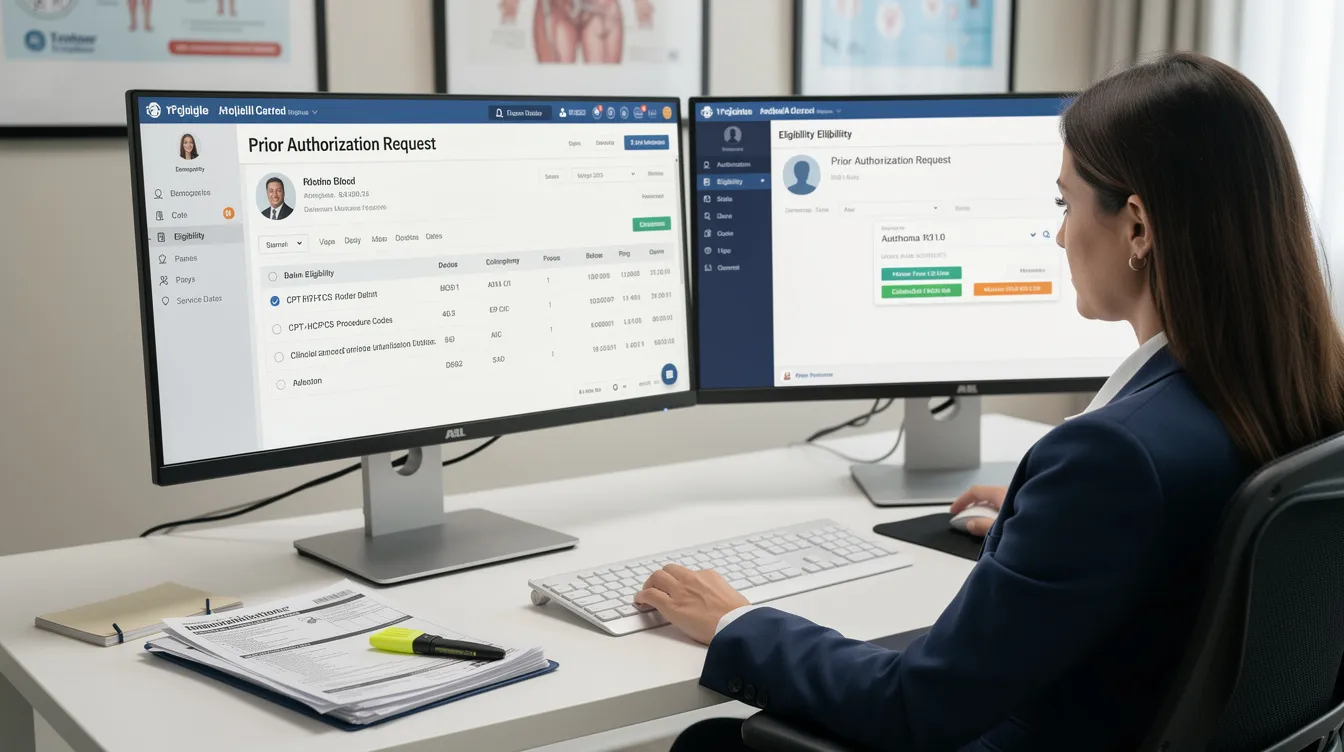
Here is the chronological workflow a biller follows for prior authorization in medical billing:
-
Verify eligibility and benefits. Confirm the patient is active, identify the insurance plan type (HMO, PPO, Medicare Advantage), check referral requirements, and confirm the service is a covered benefit.
-
Check authorization requirements. Look up the payer’s criteria for the specific CPT/HCPCS code, place of service, and provider specialty. Determine whether a standard or expedited/urgent request is needed.
-
Collect clinical and demographic data. Gather diagnosis codes (ICD-10), documentation of prior treatments tried and failed, lab or imaging results, provider NPI, tax ID, proposed procedure codes, and planned date of service.
-
Submit the prior authorization request. Use the payer’s web portal, electronic prior authorization tools, fax forms, or phone.
-
Track and follow up. Document the authorization number, effective and end dates, approved visits or units, and provider/location restrictions. Store this in the billing software or EHR so it appears correctly on the claim.
-
Incorporate authorization into the claim. When filing via CMS-1500 or electronic submission, include the auth number and ensure the service date, diagnosis, provider NPI, and location match what the payer authorized.
MedicalBillingCourse.com students practice mock workflows for prior authorization in medical billing, from checking requirements to recording the authorization number on a sample CMS-1500 claim.
Manual vs. Automated Prior Authorization
Traditional prior authorization in medical billing still often relies on manual workflows: phone calls, faxes, and paper forms. Long hold times, lost faxes, and inconsistent payer rules lead to administrative errors and avoidable denials.
Automated prior authorization in medical billing means using integrated EHR/billing software, payer APIs, and electronic prior authorization (ePA) tools that auto-check requirements and submit requests digitally. This can reduce approval times significantly, often from several days down to 24-48 hours.
Under CMS’s Interoperability and Prior Authorization Final Rule (CMS-0057-F), Medicare Advantage organizations and specified Medicaid and CHIP programs must send prior authorization decisions for medical items and services, excluding drugs, within seven calendar days for standard requests and 72 hours for expedited requests. These decision-timeframe requirements took effect in 2026. CMS estimates that the broader prior authorization and interoperability policies will produce approximately $15 billion in savings over 10 years.
While small practices may not have AI-driven tools, even basic portal use and standardized internal checklists significantly improve efficiency. MedicalBillingCourse.com’s curriculum familiarizes learners with typical screens and fields in modern billing software so they understand how automation fits into daily work.
Common Prior Authorization Errors and Denials
A large share of denials tied to prior authorization in medical billing stem from process mistakes rather than coding errors alone.
Common errors include: not obtaining prior authorization when required (assuming a referral is sufficient); wrong CPT/HCPCS code on the request; missing clinical documentation; service date outside the authorized range; provider or location mismatch; and retroactive authorization attempts after the service was already delivered.
Billers should read denial codes on remittance advice (EOB/ERA) carefully; codes indicating missing or invalid authorization point to correctable issues.
Best Practices to Reduce Prior Authorization Delays
Billers cannot eliminate prior authorization in medical billing, but consistent workflows dramatically reduce delays and denials.
-
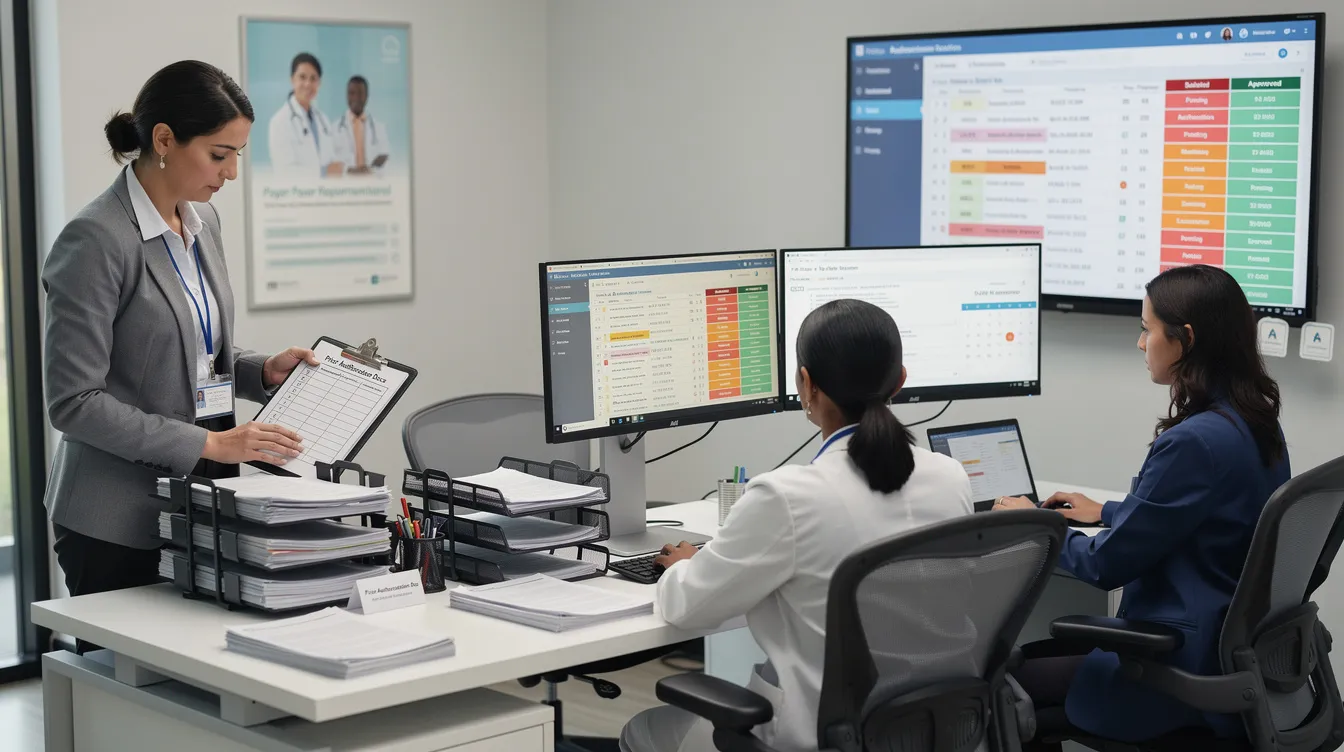
Maintain a payer-specific authorization matrix listing services that require prior authorization, typical lead times, required documentation, and expiration periods.
-
Train front-office and scheduling staff to identify when a service may need prior authorization and which internal forms to complete before referring to the billing team.
-
Ensure thorough provider documentation of medical necessity: clear diagnosis, prior conservative treatment tried, severity, and functional limitations.
-
Use payer web portals and electronic tools whenever available, and track turnaround times for each insurer to set realistic scheduling expectations.
-
Submit the request as early as the payer’s requirements and the planned service date allow.
-
Dedicate staff to authorization management. Even small practices benefit from assigning clear ownership of this task.
Skills in organizing, documenting, and communicating across the team are core competencies that MedicalBillingCourse.com emphasizes for new billers in its certification programs.
Career Skills: Working with Prior Authorizations as a Medical Biller
Prior authorization in medical billing is one of the responsibilities medical billers may encounter as part of revenue cycle work, although the exact division of responsibilities varies by practice and employer.
Daily tasks in prior authorization in medical billing include logging into multiple payer portals, checking the status of outstanding authorizations, calling insurers for missing information, and updating providers on prior authorization approval or denial. A biller often coordinates between a healthcare provider, the patient, and the insurance company simultaneously to keep the process moving.
In some practices, prior authorization work is handled by billing staff; in others, it may be assigned to scheduling, clinical, or dedicated authorization teams. Understanding the workflow helps billers coordinate effectively when authorization information affects claim submission.
For a medical biller, the key is understanding where prior authorization in medical billing fits into the larger revenue cycle: verify requirements before service, submit accurate information, track the payer’s decision, document the authorization details, and make sure the eventual claim matches what was approved. Consistent execution at each step can help prevent avoidable authorization-related denials and payment delays. If you are ready to build these skills, explore MedicalBillingCourse.com’s 2026 Edition training programs and choose the certification track that matches your career goals.

Tri Smith is a Managing Partner and Instructor at MedicalBillingCourse.com, where he helps guide the program’s direction, curriculum, and student experience. With more than six years of experience, he focuses on practical medical billing skills, including claims, payer communication, compliance, and the full billing lifecycle.
Tri also helped lead the development of the 2026 course edition, including the Medical Billing and Coding certification track. His approach emphasizes clear instruction, practical application, and preparing students to apply what they learn in real-world billing environments.


