
How to Prepare for a Medical Billing Certification Exam
- 10/12/2026
- Posted by: Tri Smith, Instructor
- Category: Certification
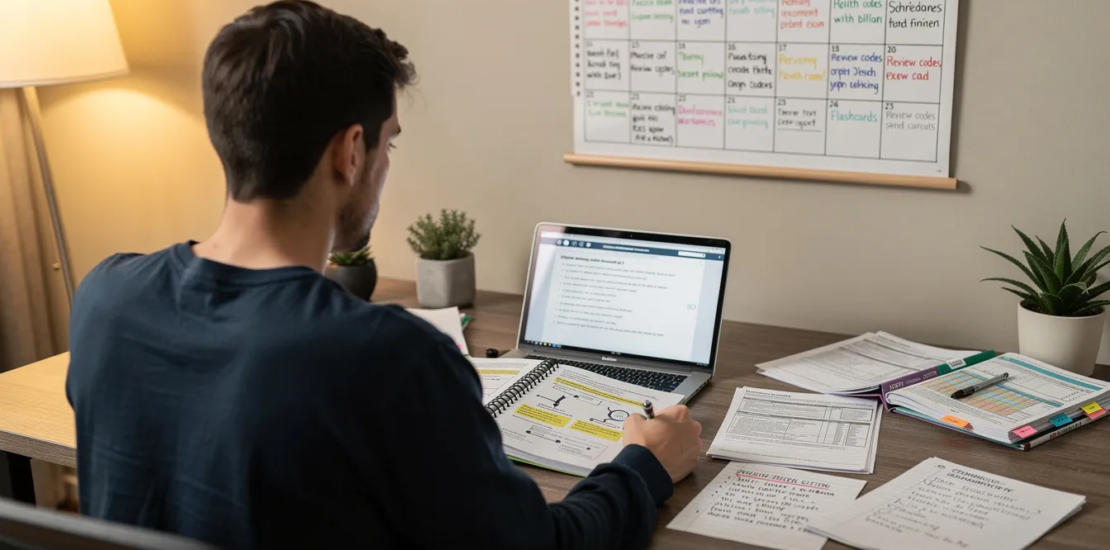
Learning how to prepare for a medical billing certification exam starts with a structured approach that balances content knowledge with hands-on practice. Medical billing translates healthcare services into claims for payment, while medical coding assigns standardized codes to diagnoses and procedures. Together, these functions drive how healthcare providers get paid. This guide walks through each step of exam prep so you can approach test day with clarity and confidence.
1. Understand Your Certification Options and Exam Format
Before you begin studying, decide whether you are pursuing a pure medical billing credential, a medical coding credential, or a combined billing and coding certification. Each path tests different knowledge, and your choice shapes your entire study plan.
Billing and coding certification exams vary by credential, but their subject matter generally falls into a few categories:
-
Billing-focused exams may cover revenue cycle management, insurance types, claim submission, denials, appeals, payer rules, and related billing concepts.
-
Coding-focused exams may test CPT, ICD-10-CM, HCPCS Level II, modifiers, coding guidelines, and compliance concepts. Whether reference materials are permitted depends on the specific exam.
-
MedicalBillingCourse.com’s Medical Billing Certification focuses on billing fundamentals and insurance processes, with additional tracks that add coding or home-based business training.
CPT, ICD-10-CM, and HCPCS Level II are coding systems that may appear in billing and coding certification content, depending on the credential.
Topics you may need to review:
-
Revenue cycle from patient registration through payment posting and appeals
-
CMS-1500 and UB-04 claim forms
-
CPT procedure codes, ICD-10-CM diagnosis codes, HCPCS Level II
-
Payer types: Medicare, Medicaid, commercial payers, TRICARE
-
HIPAA compliance and coverage determination rules
2. Map the Exam Content Outline into a Study Plan
Mapping the content outline into a study plan is a critical step in how to prepare for a medical billing certification exam. Once you decide on your credential, download the official exam content outline from your certifying body. Creating a study schedule keeps you from cramming or skipping critical topics.
Turn that outline into a week-by-week calendar based on the time you have before the exam. For example, a 6- to 12-week plan might include:
-
Break the outline into concrete topics: medical terminology, ICD-10 coding, claims processing, anatomy basics, insurance types, revenue cycle management, denials, compliance, and coding fundamentals.
-
Assign modules to specific weeks: for example, Week 1 covers HIPAA and patient privacy; Week 2 focuses on the CMS-1500 and the claim life cycle; Week 3 addresses insurance types; later weeks cover coding, denials, and mock exams.
-
Prioritize topics according to the weighting shown in the content outline for your specific exam.
-
Mirror your course sequence: students using MedicalBillingCourse.com can align their study plan with the built-in course structure to avoid gaps.
3. Build Strong Medical Billing and Coding Fundamentals
Strong billing fundamentals matter more for how to prepare for a medical billing certification exam than simply memorizing practice answers. Review the terminology, workflows, and technical concepts identified in the content outline for your specific exam.
Billing basics to review: patient registration and verifying insurance benefits; prior authorization and referral requirements; charge entry from a superbill or encounter form; claim submission through a clearinghouse; payment posting and reconciliation; and collections follow-up on unpaid claims.
Coding concepts to review when they are included in your exam: ICD-10-CM codes, which link diagnoses to services that support medical necessity; CPT codes for procedures, including office visits, surgery, and the medicine series; HCPCS Level II for supplies, injections, and durable medical equipment; and modifier use, especially for bilateral or multiple procedures.
Learn key documentation terms, such as the difference between a diagnosis and signs/symptoms and chronic versus acute conditions.
4. Master the Revenue Cycle, CMS-1500, and Payer Rules
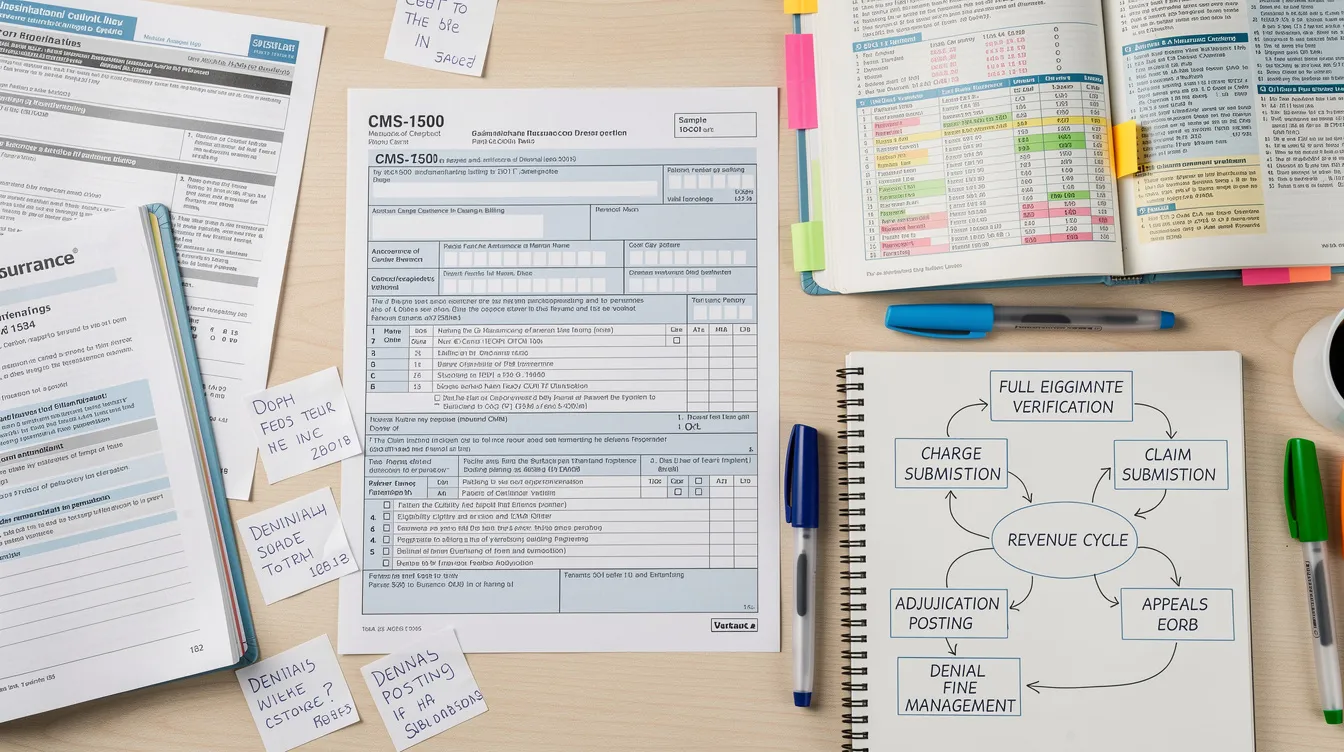
Knowing how to prepare for a medical billing certification exam also means giving revenue cycle management, claim forms, and payer rules extra attention when they are heavily weighted in your exam’s content outline. It is worth practicing with actual claims, denials, and EOB/ERA information.
Revenue cycle stages to know end-to-end: scheduling, registration, coding, billing, clearinghouse edits, payer adjudication, ERA/EOB posting, denials, appeals, and accounts receivable aging.
For the CMS-1500, practice locating patient and insured information, diagnosis codes, service-line details, diagnosis pointers, provider identifiers, and signature information. Focus on understanding what each field represents rather than memorizing isolated field numbers without context. Practice identifying errors such as incorrect provider information, mismatched identifiers, missing diagnosis pointers, and incomplete service-line information.
Payer types and rules: review government and commercial insurance concepts, managed care structures such as HMO and PPO plans, authorization requirements, network status, and any program-specific rules identified in your exam outline.
Denials and appeals: understand denial reason codes like CO-16 (claim lacks information) and CO-97, how to read ERAs and EOBs, and the process for correcting and resubmitting claims.
5. Create a Daily Study Routine and Timeline to Test Day
How you prepare for a medical billing certification exam should include a mix of theoretical knowledge and hands-on practice spread consistently over weeks, not crammed into a few marathon sessions.
-
Set a consistent study schedule you can maintain, alternating between content review and practice questions.
-
Break each session into blocks: time reading new content, time answering practice questions, and time reviewing missed answers.
-
Schedule full-length practice sessions before your test date when appropriate for your exam, matching the real exam’s question count and time limit to build pacing stamina.
-
Track your practice-test results over time and use missed questions to identify topics that need additional review. Give particular attention to consistently weak areas rather than focusing only on the overall score.
-
Self-paced learners using MedicalBillingCourse.com can align daily routines with built-in quizzes, unit exams, and the final exam to measure progress.
6. Use the Right Study Materials and Practice Exams
When you think about how to prepare for a medical billing certification exam, quality resources matter more than the number of resources you gather. Gather approved study materials before diving into content.
-
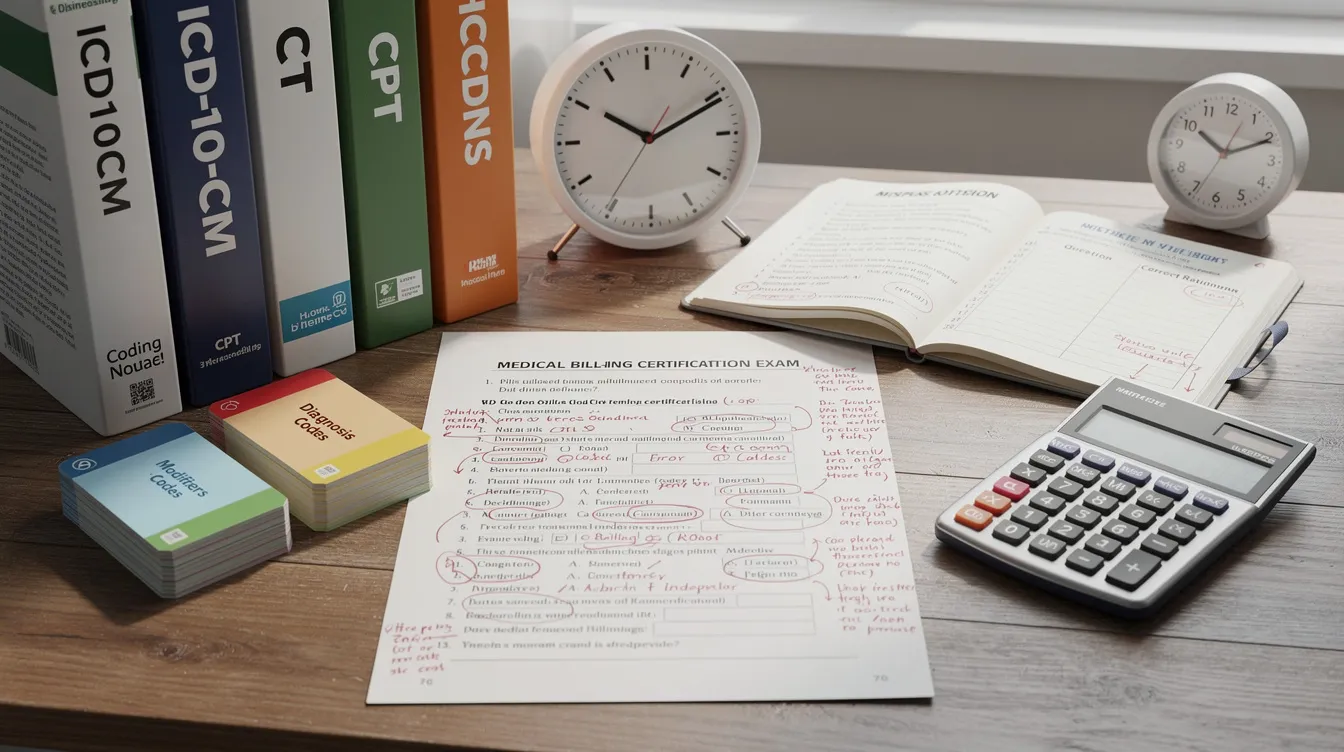
Code books: if your exam tests coding, confirm which CPT, ICD-10-CM, HCPCS Level II, or other reference materials are required or permitted. Use the editions specified for your particular exam.
-
Study guides: use materials that align with the content outline for your exam and work through review questions as you complete each topic.
-
Practice exams: complete full-length practice tests when they are available for your exam. After each one, review every missed question, trace the error back to a specific guideline or payer rule, and record it in a mistake notebook.
-
Supplemental tools: flashcards help with high-frequency terminology and codes. CMS Medicare Learning Network articles are reliable supplements.
7. Develop Effective Test-Taking Strategies
Test-taking strategy can help you use your knowledge efficiently, especially when an exam includes timed or scenario-based questions.
-
Time management: know your exam’s question count and time limit going in, and calculate your target pace per question. Mark harder questions and return to them after completing the easier group.
-
Efficient reference use: if your exam permits code books or other reference materials, organize them only in ways allowed by the exam rules and practice locating information efficiently before test day.
-
Read carefully for billing details: exam scenarios often hinge on whether the case involves primary or secondary insurance, inpatient versus outpatient setting, place of service, copays, or prior authorization.
-
Eliminate obviously wrong choices first: discard options that reference the wrong payer type, ignore medical necessity, or apply codes from the wrong range, then compare remaining answers against known rules.
8. Practice Real-World Scenarios to Reinforce Learning
Scenario-based practice is a core part of how to prepare for a medical billing certification exam, and it strengthens understanding in ways flashcards alone cannot.
-
Sample workflows to practice: verify insurance for a new patient, enter charges for a primary care visit, and complete a CMS-1500 claim with correct ICD-10 and CPT codes.
-
Denial scenarios: work through a claim denied for lack of authorization, one denied for out-of-network provider status, and one with incorrect demographics.
-
Cross-training with coding: even for billing-only certification, practice linking diagnoses to procedures that support medical necessity.
-
Write your own case studies: before exam day, map one or two patient encounters from appointment through paid claim without referencing notes.
9. Take Care of Logistics, Mindset, and Exam-Day Details
Preparing for exam-day logistics is another part of how to prepare for a medical billing certification exam, and it can prevent avoidable distractions and help you focus on the test itself.
-
Register early. Confirm your exact test date, time, location or online proctoring platform, and ID requirements.
-
Organize allowed materials at least one week out. Ensure your code books are the approved editions.
-
The day before the exam: avoid starting new topics. Do a light review of high-yield summaries, then get a full night’s sleep.
-
Manage anxiety on exam day: use deep breathing, check the clock periodically, and move past any confusing question on the first pass rather than stalling.
-
Dress rehearsal: MedicalBillingCourse.com students can use their final course exam as an opportunity to practice their pre-exam routine and time-management strategies.
The strongest way to prepare for a medical billing certification exam is with a plan built around the requirements of your specific exam: know the content outline, study consistently, practice applying what you learn, and use your results to focus additional study where it is needed. Demand for this field continues to grow according to the U.S. Bureau of Labor Statistics, which makes earning a certification a meaningful step toward a stable healthcare career.

Tri Smith is a Managing Partner and Instructor at MedicalBillingCourse.com, where he helps guide the program’s direction, curriculum, and student experience. With more than six years of experience, he focuses on practical medical billing skills, including claims, payer communication, compliance, and the full billing lifecycle.
Tri also helped lead the development of the 2026 course edition, including the Medical Billing and Coding certification track. His approach emphasizes clear instruction, practical application, and preparing students to apply what they learn in real-world billing environments.


