Anti-Kickback Statute in Medical Billing: Compliance, Penalties, and Practical Examples
- 10/08/2026
- Posted by: Tri Smith, Instructor
- Category: Compliance

What Is the Anti-Kickback Statute?
Anti-kickback statute in medical billing compliance starts with the federal Anti-Kickback Statute, an important fraud and abuse law for medical billing and coding professionals to recognize. Enacted in 1972, this criminal statute prohibits knowingly and willfully offering, paying, soliciting, or receiving remuneration to induce or reward referrals or generate business in connection with items or services payable by federal health care programs. Anti-kickback arrangements can affect otherwise routine claims, creating compliance risk for healthcare providers and billing operations.
This article covers what the statute prohibits, how it relates to other federal fraud and abuse laws, its penalties, the safe harbors that protect legitimate arrangements, practical billing scenarios where risk appears, and compliance steps for billers and coders.
The Anti-Kickback Statute is part of a framework of federal law every billing professional should recognize by name. These laws work together; a single improper payment can trigger liability under multiple statutes.
-
Federal Anti-Kickback Statute (42 U.S.C. Section 1320a-7b(b)): A criminal law that prohibits offering, paying, soliciting, or receiving remuneration to induce referrals for items or services covered by federal health care programs.
-
Federal False Claims Act: A civil statute that can impose liability for knowingly submitting, or causing the submission of, false or fraudulent claims to the federal government.
-
Civil Monetary Penalties Law (CMPL): Authorizes civil monetary penalties and exclusion for kickback-related violations, beneficiary inducements, and other prohibited conduct.
-
Physician Self-Referral Law (Stark Law): A civil statute that generally prohibits certain physician referrals for designated health services when a prohibited financial relationship exists, unless an exception applies.
-
Exclusion Authorities: The HHS Office of Inspector General can exclude individuals or entities from federal programs, subject to the applicable exclusion rules.
Federal agencies have different enforcement and oversight responsibilities under these laws, and violations can affect reimbursement, program participation, and billing operations.
What the Anti-Kickback Statute Prohibits
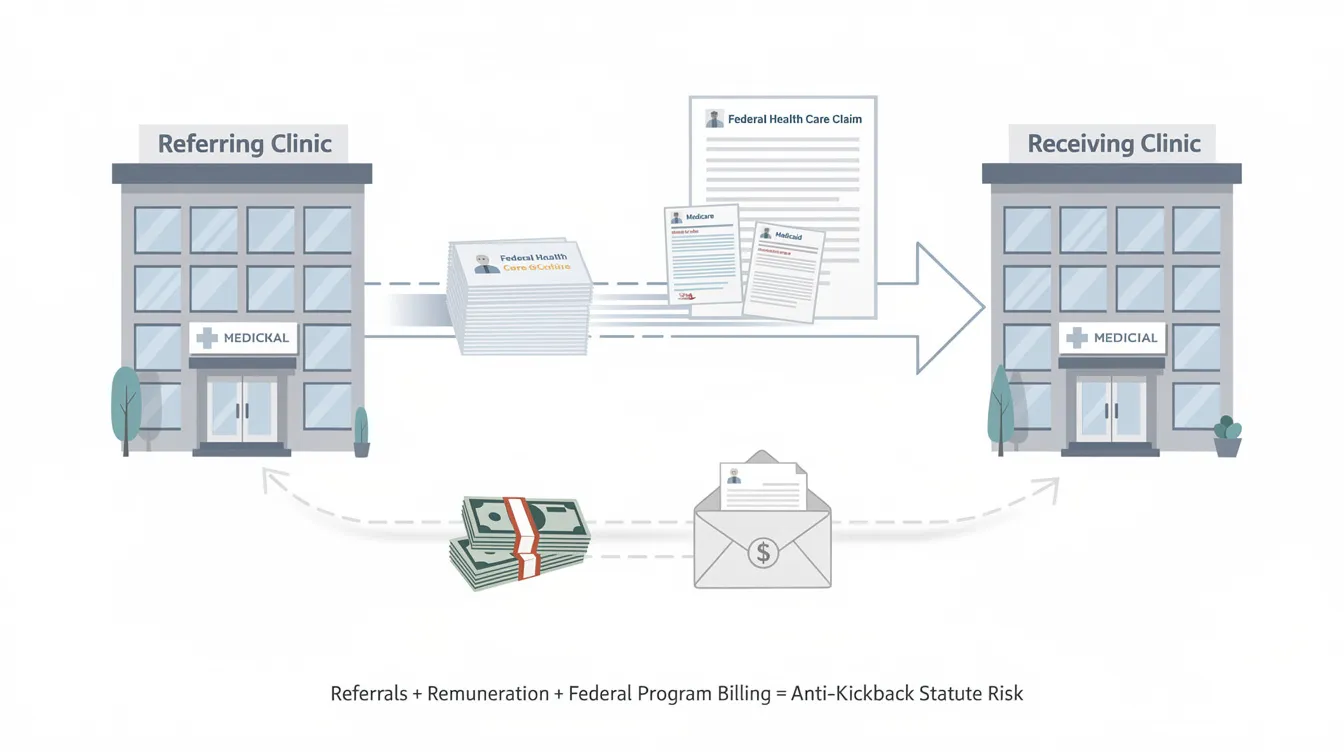
The statute prohibits offering, paying, soliciting, or receiving anything of value to influence patient referrals or generate business in connection with items or services payable by federal health care programs. It targets both sides of the transaction: the payer and the recipient of the kickback can each face liability, even if the underlying healthcare services were medically necessary and actually delivered.
Remuneration under the statute is broad, including cash payments; gifts or event tickets; free or below-market rent for office space or equipment; excessive compensation for speaker fees, consulting, or medical directorships; free supplies or staffing provided to referring practices; and travel or entertainment.
The Anti-Kickback Statute includes an intent requirement, and courts have examined whether inducing or rewarding referrals was a purpose of the remuneration. Because application of that standard depends on the specific facts and governing law, billers should treat suspicious financial arrangements as compliance issues to escalate rather than legal determinations to make themselves. Provider types commonly implicated in enforcement actions include physicians, hospitals, laboratories, imaging centers, pharmacies, durable medical equipment suppliers, and home health agencies.
Anti-Kickback Statute vs. Stark Law and the False Claims Act
For anti-kickback statute in medical billing compliance, these three statutes frequently appear together in enforcement actions, but they address different legal problems.
Stark Law generally prohibits certain physician referrals for designated health services when a prohibited financial relationship exists, unless an applicable exception is satisfied. Unlike the Anti-Kickback Statute, Stark does not depend on proving intent. Compliance with Stark Law does not ensure compliance with the Anti-Kickback Statute; an arrangement might satisfy a Stark exception but still violate the kickback statute because of the intent behind the payments.
Claims that include items or services resulting from an Anti-Kickback Statute violation can also create False Claims Act exposure, even when the billing codes themselves are accurate.
Anti-Kickback Statute Penalties
Anti-Kickback Statute violations can carry significant criminal and civil consequences, including fines, imprisonment, monetary penalties, and exclusion from federal health care programs.
Criminal violations can result in substantial fines and up to 10 years of imprisonment for a substantive Anti-Kickback Statute offense. Separate civil and administrative consequences can include monetary penalties, assessments based on the remuneration involved, False Claims Act liability, and exclusion from federal health care programs. Because monetary penalty amounts can be adjusted over time and depend on the applicable enforcement authority, billers should rely on current federal guidance rather than memorizing a fixed dollar amount.
Recent federal enforcement actions illustrate how these laws are applied. In January 2026, Labtech Diagnostics (Anderson, South Carolina) agreed to pay at least $6.8 million to settle allegations of kickbacks to physicians disguised as office rent and phlebotomy and toxicology service payments. In June 2026, Advanced Pathology Solutions, an Arkansas anatomic pathology laboratory, agreed to pay $30 million to settle allegations of unlawful kickbacks to gastroenterology practices nationwide tied to unnecessary pathology testing.

Safe Harbors and Legitimate Business Arrangements
The statute is intentionally broad. To avoid criminalizing legitimate business practices, Congress and HHS OIG have established statutory exceptions and regulatory safe harbors that identify circumstances in which certain arrangements receive protection.
Safe harbors relevant to billing operations include bona fide employment relationships, personal services and management contracts with written agreements at fair market value, space and equipment rental at fair market value with a written commercially reasonable lease, and properly disclosed discount arrangements and group purchasing.
An arrangement must fit squarely in a safe harbor to be protected; if even one element is missing, it loses automatic protection and is evaluated on its facts and intent. Fair market value alone is not a complete defense; even at market rate, an arrangement can still violate the statute if the intent is to induce or reward referrals. Falling outside a safe harbor does not automatically make an arrangement illegal, but it raises the risk and typically calls for legal review.
Anti-Kickback Red Flags Medical Billers May Encounter
Billing teams rarely negotiate physician contracts, but they sit at the point where red flags become visible. For billing and coding professionals, recognizing potential anti-kickback concerns is an important part of compliance awareness.
Concrete examples billing staff might encounter: a sudden spike in referrals from one physician following a new consulting or marketing agreement; patterns of free lab testing or equipment provided only to patients of specific referring physicians; routine waiving of patient copayments tied to certain referral sources; excessive compensation for a medical director role with no documented duties; or standing orders for tests placed before any individualized patient assessment.
Claims for items or services resulting from an Anti-Kickback Statute violation can create False Claims Act liability even when the coding and clinical documentation otherwise appear routine. When something looks unusual, the right response is to ask questions, support internal compliance reviews, and escalate concerns through proper channels rather than altering or ignoring documentation.
Enforcement agencies and whistleblowers have uncovered recurring patterns. A laboratory may pay physicians per-test processing fees or provide free specimen cups or phlebotomy staffing in exchange for referrals; in 2024, Precision Toxicology agreed to pay $27 million to resolve allegations involving free point-of-care drug test cups offered to physicians in exchange for referrals and medically unnecessary testing. Durable medical equipment suppliers may offer free staff, equipment, or cash payments to clinics in exchange for orders.
Hospitals or labs may pay excessive compensation for medical directorships where the physician performs little or no documented service, and patient-facing benefits, including routine copayment waivers or transportation arrangements, can raise compliance concerns depending on how they are structured and whether an applicable exception or safe harbor applies.
Practical Compliance Steps for Medical Billers
While anti-kickback compliance is a legal and leadership responsibility, billing and coding professionals are a first line of detection.
-
Document everything. Maintain accurate records of services performed, contracts in place, and the basis for all compensation arrangements.
-
Treat compensation arrangements tied to referrals or federal health care program business as potential compliance concerns and escalate them through the organization’s established review process.
-
Learn your organization’s compliance policy and how to report concerns internally and, when necessary, externally.
-
Avoid code or date manipulation. Never alter billing records to accommodate questionable marketing or referral schemes.
-
When an arrangement raises unresolved Anti-Kickback Statute questions, follow the organization’s compliance process and involve qualified legal counsel when appropriate.
For medical billing professionals, the practical responsibility is not to determine whether a financial arrangement is legally permissible. It is to recognize potential warning signs, maintain accurate billing records, avoid altering claims or documentation to accommodate questionable arrangements, and follow established compliance procedures when concerns arise. Understanding anti-kickback statute medical billing compliance helps billers see why technically accurate coding alone does not make every claim compliant, and it is part of the compliance awareness MedicalBillingCourse.com builds into its certification tracks alongside CPT and ICD-10 coding, CMS-1500 completion, and revenue cycle training.

Tri Smith is a Managing Partner and Instructor at MedicalBillingCourse.com, where he helps guide the program’s direction, curriculum, and student experience. With more than six years of experience, he focuses on practical medical billing skills, including claims, payer communication, compliance, and the full billing lifecycle.
Tri also helped lead the development of the 2026 course edition, including the Medical Billing and Coding certification track. His approach emphasizes clear instruction, practical application, and preparing students to apply what they learn in real-world billing environments.